

9 Common Parallel Parking Test Errors
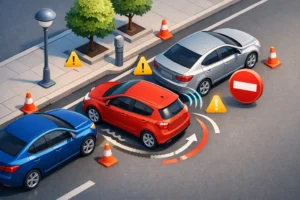
That moment comes fast on a road test. You pull up beside the car, the examiner says to parallel park, and suddenly a skill you practiced before feels much smaller, tighter, and harder. Many common parallel parking test errors happen not because a driver lacks ability, but because nerves rush the setup, timing, and observation.
Parallel parking is one of those maneuvers where small mistakes can stack up. A weak starting position leads to a poor angle. A late steering correction puts you too far from the curb. Looking only at the curb makes you forget traffic, pedestrians, or the car behind you. The good news is that most of these mistakes are predictable, which means they can be corrected with the right habits.
Why common parallel parking test errors happen
On a driving test, parallel parking is not just about getting the car into the space. The examiner is also watching your control, awareness, judgment, and ability to stay calm under pressure. That is why a parking job that ends up “good enough” can still lose marks if the process was unsafe or disorganized.
For beginners, the biggest issue is usually trying to memorize a rigid formula without understanding what the car is doing. Reference points help, but every vehicle, curb, and parking space is a little different. In a busy area like Montreal, where streets can be narrow and traffic can feel close, adapting matters just as much as following steps.
1. Starting in the wrong position
One of the most common parallel parking test errors happens before the car even begins to reverse. If you stop too far from the parked car, your vehicle will swing wide and leave you far from the curb. If you stop too close, you may not have enough room to turn cleanly.
A strong setup usually means pulling up parallel to the vehicle in front of the space with a controlled gap between the two cars. You also want your car positioned far enough forward to give the rear of your vehicle room to arc into the space.
This seems basic, but it affects everything that follows. When the setup is off, many students start making extra corrections, and that is when confidence drops.
2. Forgetting observation before reversing
Examiners pay close attention to this because it is a safety issue, not just a parking issue. Before reversing, you need a full check around the vehicle. That includes mirrors, blind spots, and awareness of anyone approaching from behind.
Some drivers signal but do not properly observe. Others check once, then start reversing several seconds later without checking again. On a test, that can look careless. Even if the space is clear when you first stop, conditions can change quickly.
The safest habit is simple: signal, stop, observe fully, then begin reversing only when the area is still clear. If a pedestrian or vehicle approaches, wait. Taking a few extra seconds rarely hurts you. Rushing often does.
3. Turning the wheel too early or too late
Timing matters in parallel parking. Turn too early and you may angle into the curb or crowd the car in front. Turn too late and your car may stay too straight, forcing a sharp last-second correction.
This is where students often rely on one exact trigger point from practice and panic when the test car, space, or parked vehicle looks slightly different. Instead of chasing a perfect script, focus on the shape of the maneuver. The first turn brings the rear of the car into the space. The second turn straightens and tucks the vehicle in.
If you understand that pattern, you are less likely to freeze when the spacing feels unfamiliar.
4. Looking only at the curb
Many anxious drivers become so focused on not touching the curb that they forget to scan everywhere else. They stare at one mirror, overcorrect, and lose track of the front of the car, the distance from the vehicle behind, or road users passing nearby.
Good parallel parking uses continuous observation, not tunnel vision. You should move your eyes between mirrors, the rear window area, the front corners of the vehicle, and your surroundings. The examiner wants to see that you can control the whole situation, not just avoid one mistake.
Ironically, drivers who obsess over the curb are often the ones who make rough corrections because they stop reading the full position of the car.
5. Hitting or climbing the curb
This is one of the clearest test-day errors because it shows a loss of space judgment or steering control. Sometimes it happens because the driver reverses too quickly. Sometimes it comes from turning the wheel too much and not correcting in time.
A light touch may be treated differently depending on the situation and examiner, but climbing the curb is a serious problem. Even when it does not cause an automatic failure, it can significantly affect the result.
The best prevention is slow speed. Parallel parking should be done with calm, controlled movement. At a very slow pace, you have time to see the angle developing and adjust before the tire reaches the curb.
6. Finishing too far from the curb
A clean-looking park is not enough if the car ends up too far out. This is one of the most common parallel parking test errors because drivers get the vehicle into the space but never fully tuck it in.
Often, this starts with the approach angle being too shallow. It can also happen when a driver is afraid of the curb and stops correcting too soon. The result is a car that may be technically parked but not positioned properly.
Most examiners expect the vehicle to be reasonably close and parallel to the curb. You do not need to chase perfection down to the inch, but you do need to show proper control. If you are safely allowed to make a correction, do it calmly rather than accepting a poor final position.
7. Using too many uncontrolled corrections
Corrections are not automatically bad. In fact, a small, deliberate correction can show maturity and judgment. The problem is when corrections become random. Forward, reverse, full lock, stop, straighten, full lock again. At that point, the maneuver can look improvised rather than controlled.
Examiners understand that learners may need to adjust. What they want to see is that each adjustment has a purpose. If the car is too far from the curb, correct for that specific issue. If the front is not clearing properly, adjust with intention.
When students struggle, it is often because they try to save a poor setup with frantic steering. A better approach is to pause, assess, and make one thoughtful correction at a time.
8. Forgetting the vehicle must end up straight
Some drivers successfully enter the space but finish at an angle. The rear may be near the curb while the front sticks out, or the whole vehicle may sit crooked between the two parked cars.
This matters because parallel parking is not finished when the car is inside the space. It is finished when the vehicle is parked securely, parallel to the curb, and positioned with reasonable space around it.
This is where the second half of the maneuver deserves more attention. After the rear enters the space, drivers often relax too early. Stay focused until the wheels are straight and the vehicle is properly aligned.
9. Letting stress control the maneuver
This last one causes many of the others. Nervous drivers rush, hold the wheel too tightly, forget to breathe, and treat every small imperfection as a disaster. Then the maneuver gets worse because the mind is racing ahead to the result.
A road test is not looking for a dramatic parking performance. It is looking for a safe, competent one. That means steady speed, good observation, smooth steering, and reasonable corrections if needed.
If you feel yourself getting tense, slow the process down. Stop the car if necessary. Recheck your surroundings. Reset your hands. A calm pause usually looks better than a panicked reaction.
How to avoid common parallel parking test errors in practice
The fastest improvement usually comes from practicing the same routine until it feels familiar under pressure. That means using the same observation sequence, keeping a very slow reverse speed, and learning what your car looks like at different angles rather than depending only on memorized cues.
It also helps to practice in more than one setting. A wide quiet street can build confidence, but it may not prepare you for the tighter spaces and visual distractions that make test-day parking harder. If you are preparing for a Quebec road test, realistic practice matters. A patient instructor can often spot whether your issue is setup, timing, steering, or simple anxiety, and that saves a lot of frustration.
At Montreal City Motor League, this is why focused road test preparation works so well for many students. Parallel parking problems are rarely random. They usually come from one repeatable habit, and once that habit is corrected, the whole maneuver becomes much more manageable.
What examiners usually want to see
Examiners are not expecting perfection. They are expecting safety, awareness, and control. If you signal properly, observe carefully, reverse slowly, and make sensible corrections, you are showing the right skills even if the maneuver is not flawless.
That is an important mindset shift for nervous drivers. Parallel parking on a test is not about proving you can perform under impossible pressure. It is about showing that you can manage the car responsibly in a common real-world situation.
If parallel parking feels like the part of the test that could ruin everything, take that as a sign to practice it more slowly, not more fearfully. Confidence usually arrives after repetition, and the best version of this maneuver is almost always the calmest one.
3 Responses