

Exam Rental Versus Personal Vehicle: Which Is Best?
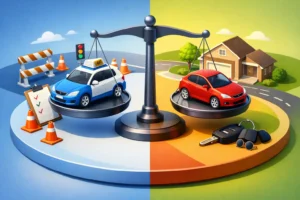
A road test can be decided by small details: a brake light that suddenly stops working, an unfamiliar parking brake, or the added pressure of borrowing a family member’s car. When considering exam rental versus personal vehicle for an SAAQ road test, the best choice is the one that leaves you free to focus on driving safely, observing carefully, and following instructions.
There is no single right answer for every learner. Your own vehicle may feel familiar and cost less. A driving school exam vehicle can offer dependable equipment, a calmer test-day routine, and often a preparation lesson immediately before the appointment. The practical question is not simply, “Which car is better?” It is, “Which option makes me better prepared to show my real driving ability?”
Exam Rental Versus Personal Vehicle: The Core Difference
A personal vehicle gives you the advantage of familiarity. You already know where the signals, wipers, defroster, hazard lights, parking brake, and fuel door are located. If you practiced your parallel parking, lane changes, and turns in that vehicle, it may feel like a comfortable part of your routine.
An exam rental is usually a driving school’s vehicle that you use for the road test, often after a final lesson or warm-up drive. These cars are maintained for instruction and are selected to be practical for new drivers. They may also have dual controls for the instructor during the preparation lesson, although the examiner evaluates your driving independently during the test.
The rental does not guarantee a passing result. Safe observation, speed control, right-of-way decisions, positioning, and proper maneuvers still determine your performance. What a rental can do is reduce avoidable complications related to vehicle readiness and give you a more structured test-day experience.
When Your Personal Vehicle Is the Better Choice
Using your own car is often a sensible decision when it is reliable, fully legal for the test, and genuinely familiar to you. If you drive it regularly, you may feel more relaxed because there is nothing new to learn on the morning of your appointment.
This option can work especially well for a learner who has practiced in the same vehicle under conditions similar to the test route. You know how firmly the brakes respond, how quickly the car accelerates, and how much steering input is needed for tight parking. That familiarity can be valuable when nerves are high.
Before relying on a personal vehicle, however, check it carefully. A test can be delayed or canceled if the vehicle does not meet the required safety and documentation standards. Requirements may change, so confirm the current SAAQ rules before test day. In general, make sure the vehicle is registered, insured, safe to operate, and equipped with working lights, signals, mirrors, windshield wipers, horn, brakes, seat belts, and tires appropriate for the conditions.
You should also consider the owner of the vehicle. Borrowing a parent’s, partner’s, or friend’s car may create extra stress if you are worried about damaging it. Even a minor mistake can feel bigger when you are driving someone else’s vehicle. If that concern will distract you, the apparent savings may not be worth it.
Why Many Learners Choose an Exam Rental
The greatest advantage of an exam rental is preparation, not convenience alone. A school vehicle is typically checked regularly because it is used for training. That lowers the chance that a dead bulb, worn wiper blade, dashboard warning light, or unexpected mechanical issue will become your problem just before the test.
For anxious drivers, an exam rental can also create a clear routine. You arrive, complete a short preparation drive, review the vehicle controls, and go to your appointment in a car you have just used. That is very different from rushing from home, dealing with traffic, finding parking, and hoping the family car is ready.
A final lesson before the road test can be particularly useful for learners who tend to make errors under pressure. An instructor can help you settle into the vehicle and review the habits that matter most: full stops, shoulder checks, proper lane position, controlled braking, observation at intersections, and calm decision-making. The goal is not last-minute cramming. It is to arrive focused and composed.
At Montreal City Motor League, exam car rental can be paired with exam-focused preparation so students do not have to manage their last lesson, transportation, and test vehicle as separate problems. For many first-time drivers, that structure makes the day feel more manageable.
Familiarity Still Matters More Than the Car Itself
A well-maintained rental is helpful, but you should not wait until the test to discover how it feels. If you choose an exam vehicle, schedule practice in that same type of car whenever possible. Learn the location of the basic controls before you are sitting beside an examiner.
Pay attention to the brake sensitivity, steering feel, turning radius, mirror adjustment, and visibility around the vehicle. Practice smooth starts and stops. Try parking maneuvers in a quiet area so you understand how the car moves at low speeds. A few minutes spent adjusting the seat, mirrors, and steering wheel correctly can improve both comfort and control.
The same principle applies to a personal vehicle. Familiarity helps only if your habits are safe. A driver can be very comfortable in their own car while still forgetting shoulder checks, stopping too far past a line, or driving too quickly for a residential street. Use practice sessions to correct habits, not just repeat them.
Cost, Risk, and Test-Day Logistics
Cost is a real part of the decision. A personal vehicle may seem free, but the actual cost can include arranging an accompanying licensed driver, taking time off work, fuel, parking, and the risk of an unexpected repair or vehicle issue. If the car fails a basic readiness check, you may lose an appointment that took weeks to secure.
An exam rental has an upfront fee, but it may include the vehicle, a pre-test lesson, transportation to the testing location, and peace of mind about vehicle condition. For some learners, particularly those without reliable access to a car, it is the simplest option.
Weather should also influence your choice. In Quebec, rain, snow, slush, and ice can quickly change how a vehicle handles and how clearly you can see. If your personal car has poor tires, weak wipers, fogging windows, or unreliable heat and defrosting, it is not a good test-day choice. A vehicle that feels safe in summer may not be suitable for a winter road test.
A Simple Way to Decide
Choose your personal vehicle if you drive it regularly, it is dependable, you have practiced all required maneuvers in it, and you can complete every vehicle check without concern. It is likely the right choice when it gives you genuine confidence rather than just familiarity.
Choose an exam rental if you do not have dependable access to a suitable vehicle, you are borrowing a car that adds pressure, or you would benefit from a final lesson and an organized test-day plan. It can also be a smart choice if you are returning to driving after a long break, are new to local road-test expectations, or want an instructor’s support before the appointment.
Whichever option you choose, make the decision early. Practice in the vehicle you intend to use, confirm its readiness several days before the test, and avoid changing plans at the last minute. The right car is the one that lets you arrive calm, prepared, and ready to demonstrate the safe driving skills you have worked hard to build.