

Difference Between Class 4 and Class 5 License
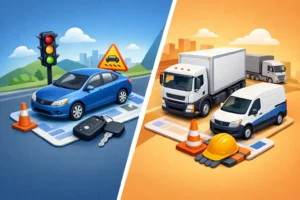
If you’re trying to figure out the difference between class 4 and class 5 license in Quebec, you’re probably asking a very practical question: what are you actually allowed to drive, and do you need the extra certification? That matters whether you’re a new driver, planning a driving-related job, or simply trying to avoid registering for the wrong training or test.
In Quebec, these two license classes are not interchangeable. A Class 5 license is the standard passenger vehicle license most people work toward. A Class 4 license is for specific professional or commercial uses, and it comes with added responsibilities. The right choice depends less on driving confidence and more on the type of vehicle, the passengers you carry, and whether driving is part of your job.
What is the difference between class 4 and class 5 license?
The simplest answer is this: Class 5 is for regular passenger vehicles, while Class 4 is for certain vehicles used to transport passengers or provide specialized services.
A Class 5 license lets you drive a typical car, SUV, van, or light truck for personal use. It is the standard license for everyday driving in Quebec and the one most teens, adults, and newcomers need.
A Class 4 license covers more specialized driving situations. In Quebec, Class 4 is divided into categories such as 4A, 4B, and 4C, depending on the vehicle and use. These can include emergency vehicles, minibuses, school buses, taxis, limousines, and vehicles used to transport paying passengers. Because those roles involve added public safety concerns, the licensing rules are stricter.
So when people compare Class 4 and Class 5, they are really comparing personal driving privileges with professional or service-related driving privileges.
What a Class 5 license allows you to drive
For most drivers, Class 5 is the main goal. It is the license used for ordinary day-to-day driving, including commuting, errands, family trips, and road travel.
With a Class 5 license, you can generally drive a passenger vehicle, a light truck, or a vehicle with a low towing capacity within Quebec’s rules. This is the license new drivers obtain after completing the graduated licensing process and passing the required knowledge and road tests.
If you are a student, a first-time adult driver, or someone returning to driving after years away, Class 5 is usually the correct path. It is also the foundation for many people who later decide to move into more specialized driving roles.
A Class 5 license does not automatically authorize you to transport passengers for hire or operate certain commercial passenger vehicles. That is where confusion often starts.
What a Class 4 license allows you to drive
Class 4 is designed for drivers whose vehicle use goes beyond personal transportation. The exact category matters.
Class 4A is associated with emergency vehicles. Class 4B is tied to minibuses and certain buses designed for smaller passenger groups, including some school transportation uses. Class 4C is typically linked to taxis, limousines, and other vehicles used to transport paying passengers.
This means a person with a standard Class 5 license may be fully legal to drive a regular car for personal use, but not legal to use that vehicle in a commercial passenger role without the proper Class 4 authorization.
That distinction is important for anyone considering work in passenger transport. Even if the vehicle itself looks like an ordinary car, the purpose of the trip can change the license requirement.
The biggest practical difference: personal driving vs. professional driving
The clearest way to understand the difference between class 4 and class 5 license is to look at the purpose of the driving.
If you are driving yourself, your family, or friends in a normal passenger vehicle, Class 5 is usually enough. If you are driving as part of a job that involves passengers, student transportation, emergency response, or paid transportation services, a Class 4 license may be required.
This is why two drivers could be sitting behind the wheel of nearly the same vehicle and still need different licenses. The issue is not always the size of the car. Often, it is the function of the vehicle and the legal responsibility attached to the trip.
Testing and medical requirements are not the same
Another major difference between class 4 and class 5 license is the qualification process.
To obtain a Class 5 license in Quebec, new drivers usually complete mandatory training, pass a knowledge test, progress through the learner and probationary stages, and then pass the road test. For most beginners, this is the standard route into legal driving.
For Class 4, the process can include additional screening. Depending on the subclass and your situation, you may need a medical assessment, a vision check, or extra knowledge requirements tied to the specific driving role. That makes sense. Carrying passengers for hire or operating an emergency or school-related vehicle involves a higher level of duty.
This is also why drivers should avoid assuming that strong everyday driving skills are enough on their own. A safe Class 5 driver may still need added preparation before applying for a Class 4 license.
Which license is right for you?
If your goal is to drive a personal vehicle, take your road test, and become independent on the road, Class 5 is the right fit. That applies to most teenagers, adult beginners, and newcomers adapting to Quebec licensing rules.
If your goal includes working as a taxi driver, limousine driver, minibus driver, or operating another passenger-service vehicle, then you need to look closely at the relevant Class 4 category.
For some people, the answer is both. You may start with Class 5 because it gives you the standard legal driving base, then move toward Class 4 later if your job plans change. That is often the most sensible route because it builds general driving confidence first.
Common misunderstandings about Class 4 and Class 5
One common mistake is thinking Class 4 is simply a more advanced version of Class 5. It is not exactly an upgrade in the usual sense. It is a different authorization for different types of driving activity.
Another misunderstanding is assuming that if you own a larger passenger vehicle, you automatically need Class 4. In reality, licensing depends on vehicle classification, seating, and use. A family van used for personal transportation does not carry the same licensing requirement as a vehicle used to transport paying passengers.
People also sometimes assume that professional driving experience from another place will transfer directly. In some cases, prior experience helps, but Quebec licensing rules still apply. If you are new to the province, it is worth checking the current requirements carefully before booking tests or accepting work.
Why this matters before you book lessons or a road test
Choosing the right license path saves time, money, and stress. If you prepare for a standard passenger vehicle road test when your work goal actually requires Class 4 certification, you may end up needing extra steps later.
On the other hand, some drivers worry they need a Class 4 license when they really only need Class 5. That can make the process feel more complicated than it is.
A good driving school can help clarify that difference early. For students focused on the Quebec Class 5 path, structured training, road test preparation, and confidence-building practice usually matter most. For drivers moving toward a professional role, the conversation should shift toward the specific license subclass and legal requirements tied to that job.
At Montreal City Motor League, this is often where clear guidance makes a real difference. Nervous beginners do better when the licensing path is explained in plain language, step by step, instead of being buried in technical terms.
A simple way to decide
Ask yourself two questions. First, am I driving mainly for personal use? Second, will I be transporting passengers as part of a regulated or paid service?
If the answer to the first is yes and the second is no, Class 5 is likely what you need. If the second is yes, you should look into the appropriate Class 4 category before moving forward.
That small distinction can prevent a lot of confusion. The best license is not the one that sounds more advanced. It is the one that legally matches the way you plan to use the vehicle.
Getting licensed should make your life simpler, not more stressful. If you’re unsure which class applies to you, take the time to confirm it before booking training, because the right start usually leads to a much smoother road ahead.