

Parallel Parking Practice Guide for Road Tests
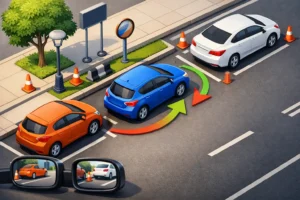
A parallel parking space can look perfectly ordinary until you are sitting in the driver’s seat, cars are waiting behind you, and every movement suddenly feels larger than it is. This parallel parking practice guide is designed to make the maneuver predictable. With a repeatable process, enough room to learn, and steady practice, parallel parking becomes a controlled low-speed skill rather than a road-test surprise.
For Québec Class 5 learners, the goal is not to perform a dramatic one-move park. The goal is to show safe observation, careful vehicle control, accurate positioning, and respect for the vehicles and curb around you. Those are the habits that also make parking in Montreal’s busy residential streets less stressful.
Start With the Right Practice Space
Choose a quiet street or empty parking area where you can practice without pressure. Traffic, pedestrians, cyclists, and parked vehicles still require your full attention, so begin at a time when the area is calm. If you are using cones, place them far enough apart that you have a generous space at first. A space about one and a half times the length of your vehicle gives beginners room to understand the vehicle’s path.
Cones are useful because they remove the fear of damaging a car, but do not stay with them forever. Real parked vehicles, curbs, road crowns, snowbanks, and uneven spaces change what you see from the driver’s seat. Once your steering sequence feels consistent, practice with real spaces that are still comfortably large.
Before every attempt, adjust your seat, mirrors, and steering wheel. You should be able to press the brake fully, turn the wheel without stretching, and see clearly through the rear window and side mirrors. A poor seating position can make a simple maneuver feel confusing.
The Parallel Parking Practice Guide: A Repeatable Method
Every vehicle has different sight lines, so avoid relying on one magic reference point from a video or another driver’s car. Learn the sequence first, then identify reference points that work in your own vehicle with an instructor.
1. Check, signal, and position your vehicle
Find a space that is legal and safe. Look for signs, fire hydrants, driveways, crosswalks, bus stops, and restrictions that may make the space unavailable. Activate your right turn signal early enough to communicate your intention to road users behind you.
Pull up beside the vehicle in front of the space, leaving roughly two to three feet between your vehicle and theirs. Your rear bumpers should be reasonably aligned. Stop smoothly, keep the brake pressed, and scan your mirrors and blind spots before reversing. A signal does not replace observation.
2. Reverse slowly while turning toward the curb
Shift into reverse only when it is safe. Look behind you through the rear window, using mirrors to support your view rather than replacing a direct check. Release the brake gently and move at walking speed.
As the rear of your vehicle begins to enter the space, turn the steering wheel toward the curb. The exact moment depends on the length of your car and the available space. What matters is that your vehicle moves diagonally into the space without cutting too close to the parked vehicle ahead.
Keep scanning. If a pedestrian approaches, a door opens, or a vehicle comes too close behind you, stop. Taking a pause is safer than trying to finish the maneuver while your attention is divided.
3. Straighten the wheels at the right angle
When your vehicle is at roughly a 45-degree angle to the curb, begin straightening the steering wheel. The goal is to guide the rear of the vehicle deeper into the space while leaving room to swing the front end in.
This is where rushing causes most errors. Turn the wheel in small, deliberate motions and keep your speed extremely low. If your angle becomes too sharp or you are getting close to the car behind, stop and assess. Correcting early is a sign of good judgment, not a failure.
4. Turn away from the curb to bring in the front
Once the rear of your vehicle is safely in the space, turn the steering wheel away from the curb. This brings the front of the vehicle inward. Continue reversing slowly until your vehicle is parallel with the curb and centered between the cars.
Avoid making contact with the curb. A light touch may happen while learning, but repeatedly climbing the curb or striking it hard suggests that the approach angle, steering timing, or speed needs work. A curb is not a guide rail.
5. Finish parked, secure, and properly positioned
Straighten your wheels and check your final position. You should be close enough to the curb to avoid obstructing traffic, but not so close that your tires rub against it. Leave practical space in front of and behind your vehicle so other drivers can exit their spaces.
Place the transmission in park, apply the parking brake when appropriate, and remain aware before opening any door. On a slope, follow the correct wheel-positioning procedure for uphill or downhill parking. Parking safely includes how you leave the vehicle, not only how you enter the space.
What Road-Test Examiners Are Looking For
A road test evaluates your decisions as much as your final parking position. An examiner can see whether you scan for hazards, signal before moving, control the vehicle at low speed, and use your mirrors and shoulder checks appropriately.
You do not need to park in one flawless motion. A careful adjustment may be acceptable when it is completed safely and without creating a risk. The stronger approach is to recognize a poor angle early, stop, and correct it calmly. Continuing toward a parked car because you feel pressured is never the right choice.
Be especially mindful of observation during reverse. Looking only at a backup camera or only at one mirror limits your awareness. Use the camera if your vehicle has one, but keep checking behind the vehicle and around it. Cameras cannot always show approaching pedestrians, low objects, or movement from the side.
Common Parallel Parking Problems and How to Fix Them
If you end up too far from the curb, you likely started turning away from the curb too soon or did not complete the final inward movement. Practice pausing at the 45-degree stage and noticing where the rear wheel sits relative to the curb.
If the rear wheel reaches the curb too quickly, slow down sooner and delay the initial turn slightly. The brake is your best tool during this maneuver. You should be able to stop at any point without panic.
If the front of your vehicle remains outside the space, you may have straightened too late or turned away from the curb too late. Rather than forcing the car backward, pull forward when safe and reset your position. In real traffic, one clean restart is better than a tight, uncertain correction.
If you lose track of your steering wheel, practice steering while stopped in a safe area. Learn how many turns it takes to move from straight wheels to full lock in each direction. Then practice returning the wheel to center. This simple exercise makes the parking sequence easier to understand.
Build Skill Before You Add Pressure
Start by practicing the same maneuver several times in a large space. Focus on one improvement at a time: better observation, slower speed, a smoother first turn, or a closer final position. Repetition creates confidence because your body begins to recognize the steering and braking rhythm.
Then make the practice more realistic. Use smaller spaces, park on different sides of the street, try locations with a mild slope, and practice in daylight before attempting low-light or winter conditions. Snow and ice reduce tire grip and can hide the curb, so allow more space and make every input gentler.
For nervous drivers, guided practice can make a major difference. A qualified instructor can identify whether the issue is timing, vehicle position, mirror use, or anxiety, then give you a method that fits your vehicle. At Montreal City Motor League, targeted refresher lessons and simulator training can help learners build that control before practicing on busier streets.
The next time a space opens up, do not judge it by whether you can park perfectly. Judge it by whether you can approach safely, move slowly, observe carefully, and make a calm correction if needed. That is how parallel parking becomes a dependable driving skill.