

10 Montreal Road Test Mistakes to Avoid
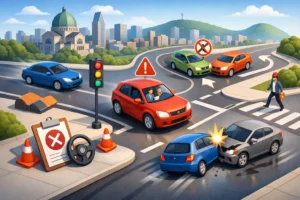
A road test can feel much harder than a regular drive because every small habit is visible. The most common Montreal road test mistakes are rarely dramatic errors. They are missed observations, incomplete stops, late decisions, or a driver who knows what to do but becomes rushed under pressure. The good news is that these habits can be identified and improved well before test day.
A successful SAAQ road test is not about driving perfectly or trying to impress the examiner. It is about showing that you can make safe, legal, predictable decisions in changing traffic conditions. That includes the busy streets, pedestrians, parked vehicles, lane markings, and intersections that make Montreal-area driving different from practicing on an empty road.
Montreal Road Test Mistakes That Cost Drivers Points
1. Looking without making your observation clear
Many new drivers check their mirrors, but they do it so quickly that they miss useful information. Others look ahead continuously but forget to scan intersections, sidewalks, crosswalks, and the space around parked cars.
Before changing lanes, merging, pulling away from the curb, or turning, use a complete routine: mirrors, signal, shoulder check, then move only when the space is safe. A shoulder check is especially important because mirrors cannot show every vehicle, cyclist, or pedestrian beside your car.
Do not turn your head excessively or take your eyes off the road for too long. The goal is purposeful observation. Your examiner should be able to see that you are checking, but more importantly, your checks must help you make a safe decision.
2. Rolling through stop signs
A rolling stop is one of the most avoidable test-day mistakes. Drivers sometimes slow down almost to a stop, then continue because the intersection appears empty. On a road test, that is not enough.
Bring the vehicle to a full stop at the correct stopping point. If there is a stop line, stop before it. If there is no line, stop before the crosswalk. If there is neither, stop where you can see safely without entering the intersection too early. Then scan carefully in both directions before proceeding.
This matters at quieter residential intersections too. An empty-looking street can still have a cyclist, child, pedestrian, or vehicle approaching from a blind spot.
3. Driving too slowly to avoid making a mistake
Nervous drivers often believe slower is always safer. It is not. Driving well below the posted speed limit when conditions are normal can interrupt traffic flow and make your actions less predictable for drivers behind you.
Aim for a speed that is legal and appropriate for the road, weather, visibility, and traffic. If rain, snow, poor pavement, or congestion calls for a lower speed, adjust smoothly and leave more following distance. If conditions are clear, do not let anxiety keep you far below the limit without a reason.
Speed control also means reducing speed early for turns, school zones, narrow streets, and areas with heavy pedestrian activity. Braking sharply at the last moment suggests that you recognized the situation too late.
4. Choosing a lane too late
Montreal streets can require quick attention to lane arrows, bus lanes, parked cars, construction, and one-way traffic. A common error is waiting until the last few seconds to prepare for a turn or follow an examiner’s direction.
As soon as you receive an instruction, check the road ahead and plan calmly. If a lane change is needed, signal early, check mirrors and blind spots, and move only when there is enough space. Never force your way into a lane because a turn is coming up.
If it is no longer safe or legal to make the requested turn, continue ahead and let the examiner redirect you. Missing a turn is generally less serious than making an unsafe lane change, crossing a solid line, or turning from the wrong lane.
5. Forgetting pedestrians and cyclists at turns
A green light does not automatically mean that a turn is clear. Before turning right or left, check the crosswalk, sidewalk entrances, and bike lane area. Pedestrians may still be crossing, and cyclists can approach quickly from behind or alongside the vehicle.
Right turns deserve special attention. After stopping where required and checking traffic, look again toward the crosswalk before moving. It only takes a moment for a pedestrian to step off the curb.
This is one area where a calm, deliberate routine protects everyone. Do not focus so heavily on vehicle traffic that you stop scanning for more vulnerable road users.
6. Poor parking setup and rushed corrections
Parallel parking, backing into a space, and parking on a hill can create anxiety because they happen at low speed with many steps to remember. The mistake is not always needing a correction. The larger problem is rushing, failing to observe, or allowing the vehicle to get too close to another car or curb.
Set up carefully before you begin. Signal when appropriate, check mirrors and blind spots, and reverse slowly while looking where the vehicle is going. Use your mirrors as support, but do not rely on them alone when backing up.
If your first position is not right, make a safe correction. A controlled adjustment is better than continuing with a poor angle. Once parked, secure the vehicle properly and follow the correct procedure for the parking situation, including the parking brake and wheel direction on a hill when applicable.
7. Letting the steering wheel pull the car through a turn
After a turn, some drivers allow the steering wheel to slide loosely back through their hands. This can lead to delayed lane control or a wide turn that enters another lane.
Steer smoothly and maintain control throughout the entire turn. Enter from the correct lane, stay in the proper lane as you turn, and finish the turn with the vehicle centered. Watch for parked cars, cyclists, and pedestrians immediately after the intersection.
Wide right turns and cutting across the center of a left turn are common habits during practice. They can be corrected by slowing down before the turn and looking farther ahead to where you want the vehicle to go.
8. Following too closely or stopping too close
Leaving space is one of the clearest signs of defensive driving. When you follow too closely, you lose time to react if the vehicle ahead brakes suddenly. When you stop too close at an intersection, you may have less room to maneuver if traffic stalls.
Maintain a practical following distance and increase it in rain, snow, darkness, or heavy traffic. As you approach a red light or stopped traffic, brake progressively rather than late and hard. A smooth stop gives you more control and makes your driving easier to predict.
At a stop, leave enough space to see the rear tires of the vehicle ahead touching the road. This is a useful reference, though the right amount of space always depends on conditions and the road layout.
9. Treating examiner directions as an emergency
Test anxiety can make a simple instruction sound urgent. A driver hears, “Turn right at the next intersection,” then signals suddenly, brakes hard, or changes lanes without checking.
Listen to the full instruction, breathe, and continue driving safely. The examiner is assessing your judgment, not how quickly you react to a command. If you need to ask for the instruction to be repeated, do so before making an unsafe assumption.
You are still responsible for traffic signs, road markings, and hazards. Follow an instruction only when it can be done legally and safely. If the situation changes, choose the safer option.
10. Practicing only the route, not the skill
Some learners try to memorize roads near the testing center. Familiarity can help reduce nerves, but route memorization is not reliable preparation. Construction, traffic, weather, and examiner directions can all change the experience.
Instead, practice the skills that transfer to any route: observation, speed management, intersections, lane changes, parking, reversing, and calm decision-making. Include different neighborhoods, busier streets, residential areas, and conditions that require you to read signs early.
A refresher lesson can be particularly useful for drivers returning to the road, newcomers adapting to Quebec driving rules, or learners who have practiced often but still feel uncertain about their habits. An experienced instructor can spot the small patterns that are easy to overlook when practicing with family or friends.
How to Prepare Without Adding More Stress
In the days before your test, avoid trying to fix every detail at once. Choose two or three skills that need the most attention and practice them with a clear routine. For example, if lane changes feel stressful, focus on timing your signal, mirror checks, shoulder check, and smooth movement into the lane.
On test day, arrive early enough to settle in without rushing. Adjust your seat, mirrors, and steering wheel before moving. Make sure you know the vehicle’s basic controls, including signals, defroster, windshield wipers, lights, and parking brake. If weather conditions change, use the appropriate controls and adjust your driving accordingly.
The road test is a short snapshot, but safe driving is built through repeatable habits. At Montreal City Motor League, focused road-test preparation helps learners replace last-minute guesswork with steady, practiced routines. Give yourself permission to drive thoughtfully, take safe corrections when needed, and show the careful judgment you have been building.