

10 Top Beginner Driving Mistakes to Avoid
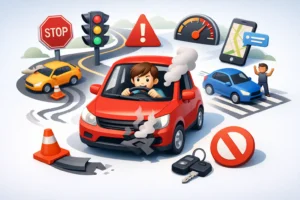
A lot of new drivers worry about one big mistake that ruins the whole lesson or road test. In reality, the top beginner driving mistakes are usually small, repeated habits – the kind that build up when a driver is nervous, rushing, or simply trying to manage too many things at once.
That is actually good news. Small habits can be corrected. With the right instruction and enough guided practice, most beginners improve much faster than they expect.
Why beginner mistakes happen so often
New drivers are not just learning how to steer a car. They are also learning how to scan, judge speed, read signs, anticipate other road users, and stay calm under pressure. For beginners, these tasks do not yet feel automatic.
This is why a student can do very well in a parking lot, then struggle in traffic. The issue is not usually intelligence or effort. It is workload. When the brain is overloaded, simple errors appear – missed mirror checks, late braking, wide turns, or hesitation at intersections.
That is also why practice needs structure. Random driving time helps less than many people think. Focused coaching helps beginners notice patterns, correct them early, and build safe habits before those habits become difficult to change.
Top beginner driving mistakes that affect safety and test results
1. Looking too close to the front of the car
One of the most common mistakes beginners make is focusing only on what is directly ahead. When a driver stares just a short distance in front of the hood, everything feels sudden. Stops feel abrupt, turns feel rushed, and hazards seem to appear out of nowhere.
A better habit is to keep your eyes moving and look farther down the road. This gives you more time to react and makes your driving smoother. You still check what is near you, of course, but your main view should not be locked too close to the vehicle.
2. Forgetting mirror checks and blind spot checks
Many beginners know they are supposed to check mirrors and blind spots, but they do it inconsistently. Sometimes they only think about it during lane changes. Sometimes they move their eyes but not in a clear, deliberate way.
This matters for both safety and road tests. Examiners want to see that your observation is active, not assumed. Before changing lanes, pulling away from the curb, turning where cyclists may be present, or merging, your checks need to be timely and visible. If you skip them, even one moment of inattention can create a dangerous situation.
3. Braking too late or too hard
Hard braking usually starts earlier than the brake pedal. It starts with delayed observation. If you notice the light changing too late, or fail to spot slowing traffic ahead, you end up braking suddenly.
This is uncomfortable for passengers, but more importantly, it shows weak planning. Smooth braking comes from reading traffic early and leaving enough following distance. In city driving, especially in busy areas like Montreal, that extra space makes a major difference.
4. Driving too fast for the situation
Beginners sometimes assume speeding only means going above the posted limit. In practice, speed control is more nuanced than that. You can be at the legal speed and still be driving too fast for weather, visibility, tight streets, pedestrian activity, or your own experience level.
This is especially relevant in rain, snow, slush, or heavy traffic. A cautious driver adjusts speed based on conditions, not only signs. Examiners notice this, and so do instructors, because good judgment matters as much as vehicle control.
5. Hesitating too much at intersections
Caution is good. Freezing is not. Many new drivers approach intersections with uncertainty, especially when they must judge gaps in traffic or decide who has the right of way.
Hesitation often comes from incomplete understanding rather than lack of courage. If you are not fully sure who goes first at a four-way stop, or when a left turn is safe, you are more likely to wait too long or make a rushed decision at the last second. The fix is not to become aggressive. The fix is to learn the rule clearly, then practice it until your timing improves.
6. Turning too wide or cutting turns short
Turns reveal a lot about a beginner driver. A wide right turn can place you too close to another lane. A left turn taken too tightly can bring you across markings or into the wrong position.
This usually happens when speed, steering, and observation are not working together. Entering too fast makes steering harder to control. Looking at the curb instead of through the turn also affects your path. With repetition, beginners learn to slow appropriately, position the car correctly, and guide their eyes where they want the car to go.
The top beginner driving mistakes with lane control
7. Drifting within the lane
Lane position problems are common during early lessons. Some drivers stay too close to parked cars. Others drift toward the center line because they are worried about the right side of the road.
This often improves once the driver stops overcorrecting. A relaxed grip, steady vision, and better forward scanning usually solve a lot of lane drift. Beginners who constantly stare at the edges of the lane tend to make more steering corrections than necessary.
8. Changing lanes without enough planning
A lane change is not just a steering movement. It is a sequence: mirror, signal, blind spot, space judgment, smooth movement, and cancellation of the signal if needed. Beginners often know the sequence in theory but rush it in real traffic.
The result may be a late signal, an incomplete blind spot check, or a move into a gap that is too tight. When this happens, the answer is not simply to “be more careful.” It helps to practice the timing of lane changes in quieter conditions first, then build up to denser traffic.
9. Stopping in the wrong place
New drivers often stop too far past the line, too close to the car ahead, or in a position that reduces visibility for themselves and others. At stop signs and red lights, placement matters.
A proper stop should be complete, controlled, and correctly positioned. If visibility is blocked, there are times when a second forward movement is appropriate, but the first stop still needs to happen where required. This is a detail that road test candidates often underestimate.
10. Letting nerves take over decision-making
This may be the most human of all beginner mistakes. A nervous driver may know exactly what to do during a lesson review, then forget it under pressure. They may rush because another driver is waiting, or panic after one small error and lose focus for the next few minutes.
The goal is not to eliminate nerves completely. Most beginners feel them. The goal is to keep nerves from taking control. Good preparation, familiar routines, and repeated practice in test-like situations help more than positive thinking alone.
How to fix beginner driving mistakes faster
The fastest progress usually comes from targeted correction, not just more hours behind the wheel. If a student keeps repeating the same error, such as late observation or poor turns, they need specific feedback on why it is happening.
That is where structured instruction makes a real difference. A qualified driving school can break the skill into steps, correct the habit early, and help the student practice in a controlled way. For anxious beginners, simulator training can also be useful because it reduces pressure while building scanning, reaction, and decision-making habits.
It also helps to practice one focus area at a time. If you try to fix speed control, lane position, parking, and intersection judgment all in one session, your progress may feel slow. If you work on one or two habits consistently, improvement becomes easier to notice.
What beginners should remember before a road test
Road tests are not looking for perfection. They are looking for safe, consistent, and responsible driving. A small mistake does not automatically mean failure. What matters is whether your habits show awareness, control, and sound judgment.
If you are preparing for a Quebec road test, this is where local training matters. Rules, examiner expectations, and traffic patterns are not identical everywhere. A school with long experience preparing Class 5 students, such as Montreal City Motor League, can help you practice the situations that matter most instead of guessing what the examiner wants to see.
Confidence at the wheel is not built by pretending mistakes will never happen. It grows when you understand your weak spots, work on them step by step, and see that each lesson makes the next drive feel more manageable. That is how beginners become safe drivers – not all at once, but one corrected habit at a time.