

Manual Versus Automatic Driving Lessons Compared
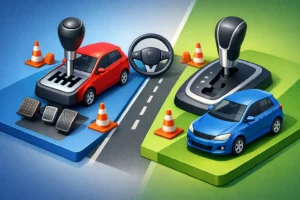
The first time a learner stalls at a green light, the question becomes very real: would an automatic car make learning easier, or is a manual transmission worth the extra work? Manual versus automatic driving lessons is not simply a question of preference. Your choice can affect how quickly you build confidence, the kind of vehicle you can drive later, and how prepared you feel when it is time for your Quebec Class 5 road test.
For many new drivers, automatic lessons offer a calmer starting point. For others, learning manual creates a stronger connection to the car and keeps more options open. The right answer depends on your goals, your comfort level, and the vehicle you expect to drive after you are licensed.
The practical difference between manual and automatic lessons
An automatic vehicle changes gears on its own. The driver focuses on steering, braking, accelerating, checking mirrors, observing signs, and making safe decisions in traffic. This reduces the number of tasks you must coordinate at once, especially during your first lessons.
A manual vehicle requires you to operate a clutch pedal and select gears yourself. You learn how to find the clutch’s engagement point, coordinate your feet and hands, shift smoothly, and select an appropriate gear for speed, hills, and changing road conditions. At first, this can feel demanding. With patient, structured practice, it becomes a skill you perform naturally.
Neither option removes the need to become a safe, attentive driver. Both require you to develop observation, judgment, lane positioning, parking skills, and defensive driving habits. The difference is where your early mental energy goes. In an automatic, more of it can go toward the road. In a manual, part of it goes toward vehicle control until shifting becomes familiar.
Why automatic driving lessons suit many beginners
Automatic driving lessons are often the most comfortable choice for anxious beginners, adult learners returning to driving, and students who want to focus closely on the road test process. Without a clutch or gear changes to manage, you may feel ready sooner to practice busy intersections, lane changes, parallel parking, and highway merging.
This can be particularly helpful in Montreal traffic, where drivers must process pedestrians, cyclists, buses, construction zones, changing lanes, and frequent stop-and-go movement. Winter conditions also demand careful attention to space, braking, and visibility. An automatic car does not make these conditions easy, but it gives a new driver fewer mechanical steps to think about.
Automatic lessons can also be a sensible option if your household vehicle is automatic, which is now the case for many drivers. The best training is the training you can continue practicing after each professional lesson. If you will have regular access to an automatic car, learning in one can create a more direct path from lessons to independent experience.
For a learner whose main objective is to complete the required training, prepare carefully for the SAAQ road test, and drive an automatic vehicle safely, this route can be efficient and confidence-building.
Automatic does not mean effortless
A common mistake is assuming an automatic car makes someone automatically test-ready. It does not. You still need controlled steering, proper mirror checks, safe turns, smooth stops, correct parking procedures, and good anticipation. You must also demonstrate that you can make calm decisions when another driver behaves unpredictably.
Automatic lessons simplify vehicle operation. They do not replace practice. A strong instructor uses that extra mental space to develop the habits that matter long after the exam: scanning ahead, maintaining a safe following distance, recognizing hazards early, and staying composed when traffic becomes complicated.
When manual driving lessons are worth the challenge
Manual driving lessons make sense when you expect to drive a manual vehicle, want the broader skill set of operating both transmission types, or simply enjoy learning how a car works. Some learners also prefer manual because they feel more involved in controlling speed and power, particularly on hills or in changing conditions.
The learning curve is real. Early manual lessons can include stalling, rough shifts, and uncertainty when starting uphill. These moments are normal, not evidence that you are a poor driver. They are part of developing coordination. A professional instructor can break the process into manageable stages: clutch control in a quiet area, smooth starts and stops, shifting at appropriate speeds, hill starts, then more complex traffic situations.
Manual training may take additional practice before you feel fully relaxed behind the wheel. That can mean more time and, depending on your needs, more lessons. Still, for the learner who plans to use a manual car regularly, that investment can prevent frustration later.
Consider your licensing and test-day plan
Before choosing a transmission type, ask how it fits your licensing plans in Quebec. Rules and conditions associated with the vehicle used for a road test can affect what you are permitted to drive afterward. Requirements can change, and individual circumstances vary, so confirm the current SAAQ rules and discuss your situation with your driving school before booking a test.
This matters most when you may need to drive a manual vehicle for work, share a family car with a manual transmission, or travel where manual vehicles are common. If you have no realistic reason to drive manual, automatic training may be the more practical decision. Choosing manual only because it seems more impressive is rarely a good reason to make your learning experience harder.
How to choose based on your real driving life
Start with the car you are most likely to drive during your first year as a licensed driver. If it is automatic, automatic lessons usually make practical sense. You will be able to reinforce the same skills between lessons and arrive at your road test familiar with the car’s basic operation.
Next, consider your comfort with multitasking. Some learners are eager to take on the challenge of clutch control. Others are already managing nerves about traffic, turns, and being evaluated. There is no prize for choosing the more difficult option if it causes so much stress that it slows your progress. A confident, alert automatic driver is safer than a distracted manual driver who is struggling to shift.
Your timeline also matters. If you are working toward a specific road test date, an automatic may help you direct practice time toward examination skills sooner. If you have flexibility and a genuine need for manual driving, give yourself enough time to learn without rushing. Confidence develops through repeated, well-guided practice, not by forcing yourself through advanced situations too early.
Finally, think about access to a suitable test vehicle. The car used for your road test must be safe, properly equipped, and familiar to you. Test-day car rental and a preparation lesson can reduce avoidable stress, especially if you do not own a vehicle or do not have someone available to accompany you.
Build the skills that matter in either transmission
Whether you choose manual or automatic, look for lessons that follow a clear progression rather than placing you immediately in demanding traffic. A good program begins with the basics, then adds complexity as your control and confidence improve. You should understand not just what to do, but why a particular decision is safer.
Simulator training can be useful before or alongside in-car practice, especially for nervous learners. It gives you a controlled way to rehearse scanning, hazards, intersections, and decision-making before those situations feel fast and unpredictable on the street. It cannot replace real driving, but it can make the first on-road lessons feel less overwhelming.
At Montreal City Motor League, the focus is on helping learners become safe, confident drivers while preparing carefully for the Quebec licensing process. That means addressing the details that can create anxiety: parking procedures, observation habits, road test expectations, and the practical realities of driving in local traffic.
Do not let someone else’s preference decide for you. Choose the transmission that supports the driver you need to become, then give yourself the time to practice until safe decisions feel steady and natural.